How to Start Working Out and Still Be Going in Week 12
A simple first workout, a week-by-week plan for your first 90 days, and honest timelines for results. Built for anyone who has started before and stalled by week five.

The plan usually dies on a Wednesday in week five. You picked six days a week back when you were rested and fired up. Then came a cold, a deadline, two bad nights of sleep, and the plan had no setting for "less." So you skipped, felt bad about skipping, and quietly stopped opening the app.
If that sounds familiar, you don't need more willpower or a cleverer program. You need a start that fits your worst week. This guide covers how to start working out so you're still at it in week 12: one simple full-body workout you can do on Monday, a week-by-week plan for your first 90 days, and honest timelines for what changes when.
Why 90 days? In a 2010 study, Phillippa Lally and colleagues at University College London had 96 volunteers repeat a new daily behavior and rate how automatic it felt. The median time to reach a plateau was 66 days, with a huge range of 18 to 254, and simple habits like drinking water got there faster than exercise routines (the study is here). Twelve weeks won't make training effortless, but it gets most people past the stretch where every session is a negotiation.
How many days a week should a beginner work out?
Three. Full-body sessions of about 40 to 45 minutes, on non-consecutive days like Monday, Wednesday and Friday.
That probably sounds too easy, and you should be suspicious of the urge to do more. Motivation peaks at the exact moment you choose your workload, then drifts down. A six-day plan fits the person you are on a fired-up Sunday night. A three-day plan fits the person you are in week five with a head cold and a full inbox.
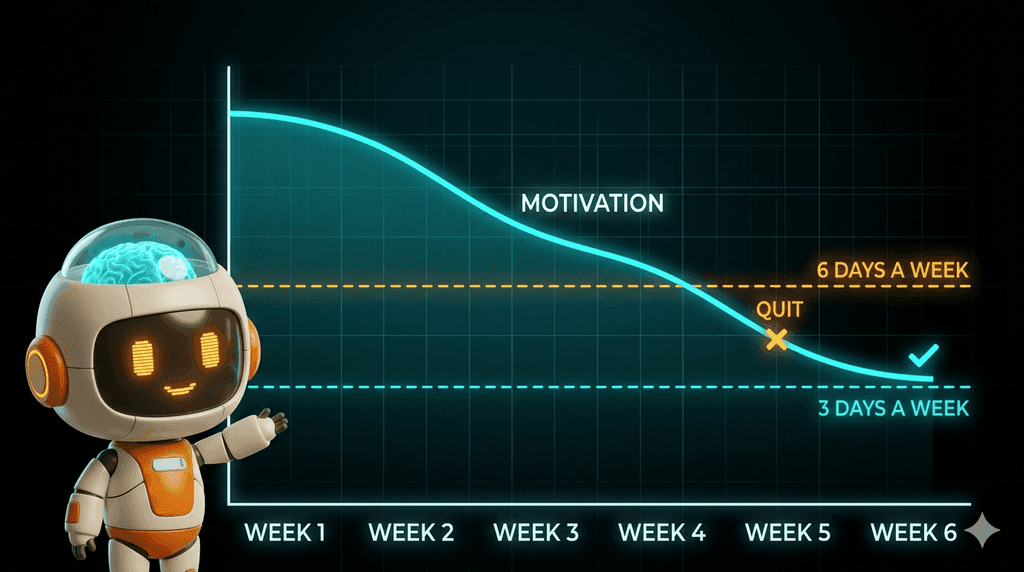
Three sessions are enough for steady progress for months. If you've quit before, it helps to understand why people quit their workout goals. The usual culprit is a plan built for someone with more free time and better sleep than you.
Your first workout (do this on Monday)
Five exercises, two sets each, about 40 minutes including the warm-up. Between them they cover the movement patterns that matter: squat, push, pull, hinge and brace.
Warm up for five to eight minutes: brisk walking or an easy bike until you're slightly warm, then one light set of the first two exercises. That's all you need, and here's more on how to warm up before lifting if you want the reasoning.
- 1.Goblet squat (one dumbbell held at your chest) or leg press: 2 sets of 10. Sit down between your heels and keep your chest tall.
- 2.Machine chest press or push-up: 2 sets of 8 to 12. If floor push-ups are too hard, put your hands on a bench or kitchen counter.
- 3.Seated cable row (or a resistance band row at home): 2 sets of 10 to 12. Pull your elbows back toward your hips and pause for a beat.
- 4.Dumbbell Romanian deadlift: 2 sets of 10. Soft knees, push your hips back until your hamstrings stretch, then stand up tall.
- 5.Dead bug: 2 sets of 6 slow reps per side, with your lower back pressed into the floor the whole time.
Rest about 90 seconds to two minutes between sets of the first four exercises and around a minute for the dead bug. Longer rest lets you put more into the next set, which matters more than keeping your heart rate up (more on how long to rest between sets).
How heavy? Pick a weight where each set ends with two or three good reps still in the tank. On day one you'll guess wrong. Write down what you used and adjust next time: if rep 12 felt like rep 3, go up; if your form fell apart at rep 7, go down.
Machines are a smart place to start. They guide the path of the movement, you don't need a spotter, and most have a diagram printed on the side. Training at home? A backpack loaded with books works for squats and Romanian deadlifts until you buy dumbbells.
Then do the same workout again on Wednesday, and again on Friday. Repetition is how you see progress: you can only beat last week's numbers if last week's workout looks like this week's.
How to start working out: your 90-day plan, week by week
Weeks 1–2: just show up
Three sessions a week of the workout above, on the same days and ideally at the same time. Keep the weights light enough that you leave feeling you could have done more. You're practicing the movements and the routine of arriving: packing the bag, finding the machines, getting out the door on a Wednesday evening. Grade yourself on attendance only. Six sessions out of six is a perfect two weeks, whatever you lifted.
Weeks 3–4: start a logbook
Write down every exercise, weight and rep count, in a notebook or your phone. Settle on working weights now, the ones where you finish each set with two or three reps in reserve. Your numbers will climb quickly in this phase.
You may be sore the day or two after sessions. That's normal and fades as your body adapts, and you can read about why muscle soreness after a workout doesn't mean it worked if you're tempted to chase it.
Weeks 5–8: add a little every time
Use the simplest progression rule there is. Work in a rep range, say 8 to 12. When you hit 12 clean reps on both sets, add the smallest weight jump available next session (usually 1 to 2.5 kg, or 2.5 to 5 lb) and build back up from 8. Some sessions you won't beat last time. Judge the trend over three or four weeks, never a single day.
This is also a good time to add a second workout and alternate them: A, B, A one week, then B, A, B the next. Workout B:
- Split squat or step-up: 2 sets of 8 to 10 per leg
- Seated dumbbell overhead press: 2 sets of 8 to 12
- Lat pulldown: 2 sets of 10 to 12
- Hip thrust or glute bridge: 2 sets of 10 to 12
- Farmer's carry: 2 walks of about 30 seconds with heavy dumbbells
Recovering well and enjoying it? Add a third set to the first two exercises of each workout. Still fighting to get there three times a week? Stay at two sets. Both are fine.
Weeks 9–12: keep going, then look back
Keep the same structure and keep nudging the numbers. If everything feels heavy for two sessions in a row and you're sleeping badly, take a lighter week: same exercises, one set each, then pick up where you left off.
At the end of week 12, open your logbook to week 3 and compare. Unless something went badly wrong, you'll be lifting more on nearly every exercise, and that page is better motivation than any mirror.
Alongside all of this, walk. A brisk 25 to 30 minutes on most days, plus your three sessions, covers the World Health Organization's 2020 guidelines for adults: 150 to 300 minutes of moderate activity a week and strength work on at least two days.
Should beginners do cardio or weights first?
If you have to pick one, lift. Strength training builds the muscle and strength that make everything else easier, and it's the part most beginners skip. Then add cardio you don't hate. Walking counts, and it's the easiest thing to keep doing in a bad week.
If you do both in one visit, lift first while you're fresh, then walk or cycle. And try not to treat cardio as punishment for what you ate on Saturday.
What else matters (and what can wait)
Two things outside the gym make a real difference in the first 90 days. Protein: a palm-sized serving at each meal gets most people into a sensible range without weighing anything. Sleep: aim for at least seven hours, because recovery and appetite both suffer on short nights.
Supplements, the perfect split, fasted cardio, training to failure, whatever your favorite fitness account swears by this month: all of it can wait until you've trained consistently for three months. Most of it can wait forever.
How long until you see results from working out?
Strength comes first, and fast. In your first weeks the numbers jump, largely because your nervous system is getting better at using the muscle you already have. In a classic 1979 study, Moritani and deVries found that neural adaptation explained most of the early strength gain, with muscle growth becoming the bigger contributor after roughly three to five weeks. Later studies have detected growth a little earlier, but the order of events holds: the logbook moves before the mirror does.
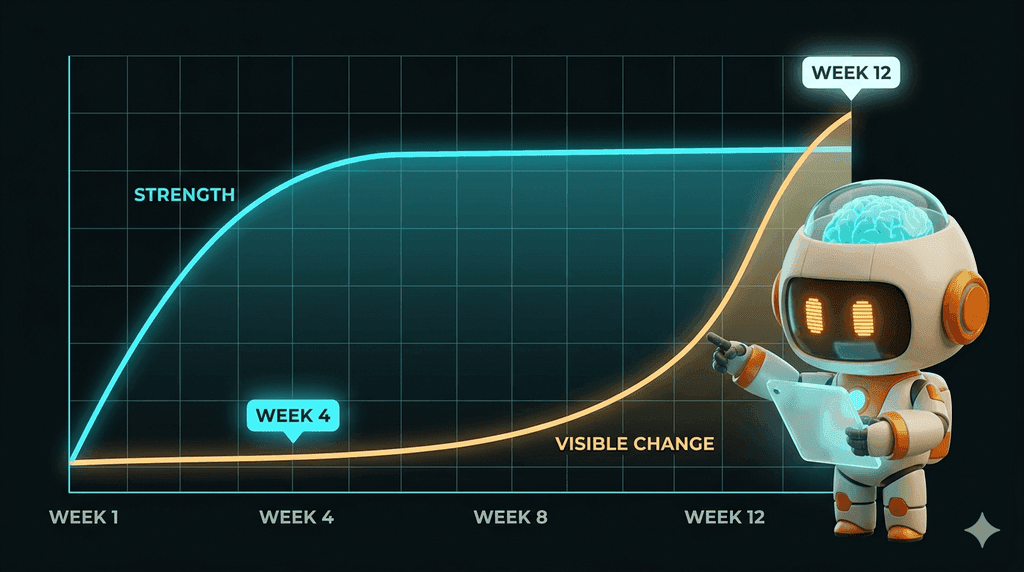
Visible change takes months. Muscle growth in a beginner is real but slow, measured in pounds over a season rather than per week. If you're losing fat, a pace of roughly 0.5 to 1 percent of body weight per week is a common target; Helms, Aragon and Fitschen recommended that range in a 2014 review as a way to hold on to muscle while dieting.
The scale bounces daily with water and salt, so only trust the two-week trend. Better feedback: your logbook, a photo once a month in the same light, and how the stairs to your apartment feel.
Nervous about the gym? Fewer people are watching than you think
Gym anxiety pushes plenty of beginners into training at home with whatever's lying around. The research is reassuring. In a 2000 study by Thomas Gilovich and colleagues at Cornell, students who walked into a room wearing an embarrassing Barry Manilow T-shirt guessed that about half the people there had noticed it. Roughly a quarter actually had. Psychologists call this the spotlight effect: we overestimate how closely others track us, mostly because they're busy thinking about their own sets.
- Go at quieter times while you learn the room. Mid-morning and later evenings are usually calmer than the 5 to 7 pm rush.
- Walk in with your workout written down, so you're never standing in the middle of the floor deciding what comes next.
- Learn the room on machines first and add free weights as you get comfortable.
- Ask staff where things are or how a seat adjusts. Answering that is part of their job.
When a week falls apart
At some point you'll miss a session. Lally's habit study has a useful finding here: missing a single opportunity did not materially affect how the habit formed. One miss is noise. Two in a row starts to feel like a new pattern, and soon you're waiting for "next Monday."
So keep two rules. Never miss twice in a row. And when a week gets crushed, shrink the workout instead of the schedule: on a bad day the deal is 15 minutes. Warm up, do the first two exercises, and you're allowed to leave. You'll often stay longer, and even when you don't, Wednesday stays a training day.
Strip this guide down and it comes to three full-body sessions a week, a logbook, and never two misses in a row. Twelve weeks of that leaves you with a page of numbers that went up, which is the best argument there is for week 13.
For most beginners the hard part is the Wednesday evening when nobody would know if you skipped. That's when it helps to have a coach expecting you, with today's workout already built and a voice in your ear from the first warm-up set. Your first three workouts are on us.
FAQ
- How do I start working out if I'm completely out of shape?
- Start with three short full-body sessions a week using light weights or machines, plus a daily walk. End every set with two or three reps still in the tank and keep the first two weeks deliberately easy. Your only early goal is showing up. Beginners gain strength quickly, so the weights will start climbing within a few weeks anyway.
- How long should a beginner workout be?
- Around 30 to 45 minutes is plenty: five to eight minutes of warm-up, then four or five exercises for two sets each, with 90 seconds to two minutes of rest between sets. Longer sessions don't help a beginner if they make you dread going. On a rough day, a 15-minute session still counts and keeps the routine alive.
- Is it normal to be sore after my first workout?
- Yes. Soreness that peaks a day or two after a new kind of workout is normal and usually fades within a few days. It gets milder as your body adapts, so less soreness later on does not mean your training stopped working. Train through mild stiffness, but stop and get checked if you feel sharp pain or swelling.
- Should beginners work out at home or at the gym?
- Either works if you actually go. A gym makes progress easier because you can add small amounts of weight to almost every exercise. Home training removes the commute and the nerves, and a pair of adjustable dumbbells or a few bands go a long way. Pick whichever has the least friction on a tired weeknight.
- Should I see a doctor before I start exercising?
- Check with your doctor first if you have heart disease, high blood pressure, diabetes, a recent injury or surgery, or if you get chest pain, dizziness, or unusual shortness of breath when you are active. Most healthy adults can begin a gradual program like this one without clearance, but a quick check is sensible if you are unsure.
Ready to train?
Not a plan. A presence.
Seven AI coaches. Real voice coaching during your workout. Start free — no credit card required.
Start Training Free