A Coach Doesn't Need a Plan. They Need One Good Coaching Cue.
One short sentence before the rep can change how the bar moves. What the attentional-focus research says, where it is shakier than coaches admit, and cues for your next set.
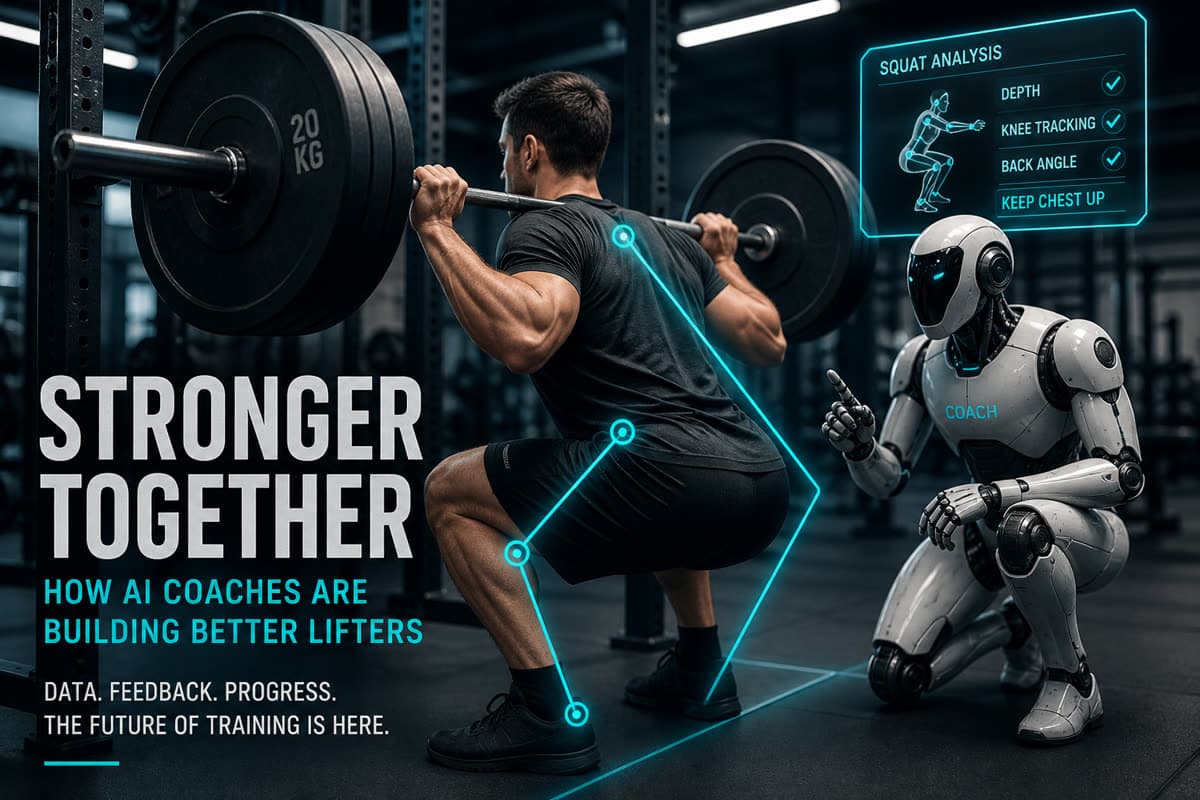
Last set of bench press, and rep three already felt heavy. A stranger from the next bench asks if you want a spot, and you say sure. On rep five the bar stalls a few inches off your chest, and before you can decide to rack it, they say four words: "Throw it at the ceiling." The bar moves. Their hands never touched it.
Nothing about elbows, triceps or leg drive. That's a coaching cue, and on that rep it did more than the program that put you on the bench. Good coaches spend most of a session quietly waiting for the one moment where a short phrase like that will do the most work.
Your program can tell you sets, reps and load, but it can't do that part. You can learn to do it for yourself, though. Below: what coaching cues are, what the research on attentional focus shows (including a recent reanalysis that took the hype down a notch), how to write cues that work, and a short list of external-focus cues for the squat, deadlift, bench press, push-up and row.
What are coaching cues?
A coaching cue is a short instruction, usually three to six words, given right before or during a movement to change how it's performed. "Brace before you bend." "Eyes on the wall." "Lead with the elbow." Cues are small on purpose, because you have to act on them in the second before you move, with no time to think them over.
Watch an experienced strength coach work with one lifter on a heavy day and the striking thing is how little they say. They load plates, watch, wait. Then, right before a set, one sentence. Most of the skill is in choosing which sentence and when. The program, the warm-up and the load jumps all exist to set up those few moments.
Cues come in two kinds, and the difference is why this topic has a research literature at all:
- Internal-focus cues point your attention at your body: "squeeze your glutes," "feel your lats," "keep your elbows tucked."
- External-focus cues point your attention at the effect you want outside your body: "push the floor away," "bend the bar," "pull the handle to your pocket."
Internal vs external focus cues: what the research shows
Most of this work traces back to Gabriele Wulf, a motor-learning researcher at the University of Nevada, Las Vegas, who has been testing one idea since the late 1990s: where you put your attention changes the movement itself.
The lifting studies are the ones you'll care about. In a 2009 study by David Marchant and colleagues, people doing elbow flexions on an isokinetic machine produced more peak torque when told to focus on moving the machine's arm than when told to focus on their own arm, and their biceps showed less electrical activity while doing it. More force for less muscle activity is what researchers mean by more efficient movement.
A 2011 follow-up from the same group had experienced lifters do as many reps as they could at 75% of their one-rep max on the bench press and the squat. With external-focus instructions they got more reps to failure than with internal-focus instructions or with no instructions at all.
Pooled data points the same way, with smaller numbers. A 2021 meta-analysis by Chua, Wulf and colleagues in Psychological Bulletin, covering 73 studies on performance, found a consistent edge for an external focus, but the effect on in-the-moment performance was small. A 2021 meta-analysis on strength by Jozo Grgic and colleagues found that an external focus gave an acute bump in strength, while weeks of training with one focus or the other made no clear overall difference to strength gains (lower-body lifts were a possible exception).
Where the evidence is shakier
In 2024 a team led by Brad McKay reanalyzed the field, also in Psychological Bulletin, this time correcting for reporting bias: positive results tend to get published while null results sit in drawers. After that correction, the estimated benefit of an external focus shrank to somewhere between small and nothing. That's a serious challenge, and the argument isn't settled.
There's also one place where internal focus seems to win. In an 8-week study by Brad Schoenfeld and colleagues, untrained men who focused on squeezing the biceps during curls grew their elbow flexors more than men who focused on moving the weight (12.4% vs 6.9% increase in muscle thickness). The quads showed no such difference. For isolation work aimed at a specific muscle, the old mind-muscle connection has some support.
Our read: for compound lifts where the goal is to move the load well, external cues are a sensible default. They cost nothing, the downside is close to zero, and the squat and bench studies point their way, even if the true effect is smaller than coaching books suggest. Test them on yourself rather than taking them on faith.
Why would they work at all? Wulf's explanation, the constrained action hypothesis, is that focusing on your body parts makes you consciously steer a movement your nervous system already knows how to run on autopilot. Point your attention at the result and the automatic system gets to do its job. It's a plausible explanation with some supporting data, not a proven mechanism.
Timing: say it before the rep, not during the grind
A perfect cue at the wrong moment mostly goes to waste. Once a heavy rep is underway you're committed to the pattern, and a full sentence shouted at the sticking point registers as noise. The spotter's four words got through because they were short and pointed at the bar, but the better moment for them was the setup: the breath before you unrack, the pause at the top before you descend.
That's why good coaches sound the way they do. Long quiet, one short line on your setup breath, quiet again. As far as we know, nobody has pinned the window down to the second in a lab, but anyone who has been yelled at mid-grind knows the difference between hype and an instruction they could actually use.
The same logic explains why five corrections in one set add up to none. Under a heavy load you can act on one thing. Pick the one that matters most and let the rest wait for next week.
It also explains why some of the most repeated gym advice backfires. "Breathe out on the way up" is a cue built for light, easy reps and aimed at the worst possible moment on a heavy one, which is why we wrote a separate piece on how to breathe when lifting weights.
How to write a good coaching cue
Cue the result, not the muscle
Say "push the floor away" instead of "squeeze your glutes," and "drive the bar to the ceiling" instead of "use your triceps." If your cue names a muscle, rewrite it so it names what should happen to the floor, the bar or the handle.
Aim it far away
The Chua meta-analysis also compared near and far external targets and found a small edge for the farther one. "Drive the bar to the ceiling" gives your attention a more distant target than "push the bar," and on the evidence so far that tends to help a little. When in doubt, point the cue at the floor, the wall or the ceiling.
Keep it under six words
If you can't say it in one breath, save it for the rest period. A cue is something you can repeat to yourself while you brace.
Use one cue per lift, per session
Choose before you walk in, and keep it for at least two sessions so you can tell whether it changed anything. Collecting cues is a way of thinking about lifting instead of lifting.
Coaching cues for squat, deadlift, bench press, push-up and row
Pick one per lift. Each of these is an external-focus cue, listed with the problem it usually helps with.
- Squat: "Push the floor away" (for a slow ascent where your chest drops first) or "Spread the floor with your feet" (for knees caving in).
- Deadlift: "Push the floor down" (for hips shooting up before the bar moves) or "Drag the bar up your legs" (for the bar drifting away from you).
- Bench press: "Bend the bar" (for elbows flaring early) or "Throw the bar at the ceiling" (for a soft, slow press off the chest).
- Push-up: "Push the floor away" (for sagging at the bottom) or "Screw your hands into the floor" (for elbows flaring out wide).
- Row: "Pull the handle to your hip pocket" (for shrugging and yanking with the arms) or "Drive your elbows toward the wall behind you" (for short, choppy reps).
None of them names a muscle. On a curl or a lateral raise done for growth, an internal cue like "squeeze the biceps at the top" is fine, per the Schoenfeld study above.
What to do in your next session
- 1.Before you train, write one cue per main lift in your phone notes. Three lifts, three cues, nothing else.
- 2.During the setup for each set, take your bracing breath and say the cue once, quietly out loud or in your head. Then lift.
- 3.During the reps, count and nothing more. If a rep starts to grind, the cue has already done its job or it hasn't.
- 4.After the set, rate it in one word: better, same or worse. Use the rest period for that, and rest long enough on heavy sets to recover (here's how long to rest between sets).
- 5.Keep the same cue for two sessions. If "better" shows up most of the time, keep it. If not, switch to the other cue on the list.
Saying a cue to yourself is a form of instructional self-talk, which has its own body of research. Our piece on self-talk in sports covers how to make the voice in your head useful rather than a running complaint.
Why most workout apps don't cue you
A workout app knows what it assigned and which buttons you tapped. It has no idea whether you're setting up, mid-rep or about to bail, so it falls back on what works without that information: a plan, a timer, a chime.
Apps that add audio often make it worse by talking at random moments: "You got this!" fifteen seconds into a rest, "Push!" after you already pushed. We wrote more about why silent workout apps fall short and what changes when a coach can actually talk to you during the session.
Start with one sentence
Before your next heavy set, decide your sentence. Make it about the floor or the bar, keep it short, say it on the setup breath, then lift and notice what the rep did.
If you'd rather not wait for a helpful stranger, CoachMoach puts a voice coach in your ear for every session, and you choose its style, from Master Ren's few calm words to Commander Iron's drill-sergeant cadence. Find the coach you'd actually listen to.
FAQ
- What are coaching cues?
- Coaching cues are short instructions, usually three to six words, given right before or during a movement to change how it is performed. Examples are "push the floor away" on a squat or "bend the bar" on a bench press. Good cues are brief enough to act on without thinking, and each one targets a single change.
- What is the difference between internal and external focus cues?
- An internal focus cue directs attention to your body, such as "squeeze your glutes" or "tuck your elbows." An external focus cue directs attention to the effect of the movement outside your body, such as "push the floor away" or "bend the bar." Most lab studies find external cues give slightly better performance, though a 2024 reanalysis suggests the effect is small.
- Are external focus cues better for building muscle?
- Not always. For moving heavy loads, external cues tend to help strength and reps to failure. For growing a specific muscle with isolation work, an 8-week study by Brad Schoenfeld and colleagues found that focusing on squeezing the biceps during curls produced more growth than focusing on moving the weight. The same study found no difference for the quadriceps.
- How many coaching cues should you use per set?
- One. Attention is limited under a heavy load, and several instructions at once tend to cancel each other out. Pick the single cue that addresses your biggest problem on that lift, say it during the setup before the first rep, and keep it for at least two sessions before judging whether it works for you.
Ready to train?
Not a plan. A presence.
Seven AI coaches. Real voice coaching during your workout. Start free — no credit card required.
Start Training Free