What an AI Fitness Coach Actually Does (and How to Spot a Fake One)
Most apps calling themselves AI coaches are a workout list with a chat box. What the real thing does during a workout, where it falls short, and how to test one in a single workout.
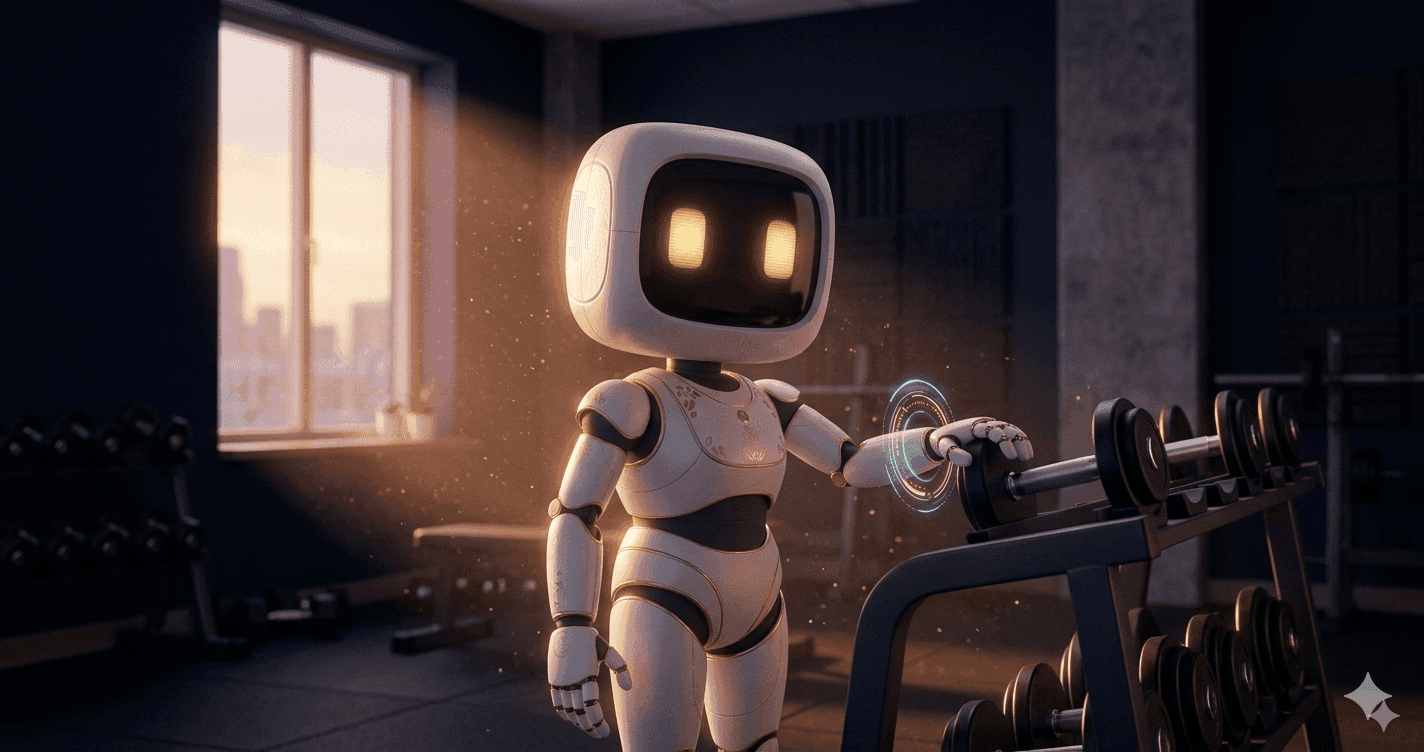
Your phone probably already has three things on it calling themselves an "AI coach." One wrote you a 12-week plan in four seconds. One is a chatbot that answers form questions. One sends you a push notification at dinner time. None of them was there at rep 7 of your last set, when your legs burned and you put the weight down three reps early.
That's the gap in most of what gets sold as an AI fitness coach: plenty of planning and reminding, and silence during the set itself, which is where the effort happens.
This guide covers what an AI fitness coach actually is, what the research on coaching suggests it can borrow from a human trainer, where it still falls short, and a six-step test you can run on any app during one normal workout.
What is an AI fitness coach?
An AI fitness coach is software that plans your training and then coaches you through it. Those are two separate jobs. Planning means choosing exercises, sets, reps and loads. Coaching means being there while you do them: timing your rest, nudging the weight up, noticing when a set fell short.
Most apps with AI on the icon do the first job well and skip the second. You'll run into three kinds:
- Workout generators. You give it a goal and your equipment; it gives you a plan. Useful, and about as interactive as a PDF once you start lifting.
- Chatbots with a fitness skin. A language model in a chat window. It can explain a Romanian deadlift well, then has no idea you're training once the phone is in your pocket.
- In-session coaches. The app speaks during the workout, knows which set you're on and how long you've rested, and remembers last week. Only this kind does the second job.
The word coach promises the third kind. The test further down tells you which one you've installed. (For why a voice matters mid-session, see the problem with silent workout apps.)
Why having someone there while you lift matters
The clearest evidence for coaching comes from studies of supervised lifting, where people training with a trainer chose heavier weights and gained strength faster than people running the same plan alone (more in the research on having a coach).
The caveat: those trainers were humans in the room. Whether a voice in your earbuds recovers part of that effect has barely been studied. A 2021 systematic review of AI chatbots for physical activity by Oh and colleagues found only nine eligible studies; five of the seven that measured activity looked promising, but the authors couldn't draw firm conclusions. Plausible and encouraging, then. Anyone promising more is selling something.
What a good AI fitness coach does well
An in-session coach has a few advantages that come straight from being software:
- It's there before dawn in your garage and late at night in a hotel gym, with no booking.
- It remembers every set. If you got 8, 8 and 6 on dumbbell rows at 45 lb last Tuesday, it can open today with that number instead of asking you to recall it.
- It keeps rest honest. Alone, it's easy to cut rest short on hard lifts and drift into five minutes of scrolling on easy ones.
- It builds a session from one sentence: "40 minutes, dumbbells only, go easy on my left wrist."
- It logs reps by voice, so the phone stays on the floor.
- It costs less per month than one session with most personal trainers.
What an AI fitness coach can't do (yet)
The limits tell you when to pay a human.
- It mostly can't see you. A voice coach knows your reps and weights, but has no idea your left knee caves on the way up. Some apps try camera form checks, a hard problem with a phone propped against a water bottle. If a lift is new to you, a session or two with a qualified trainer is money well spent.
- It can't spot you. Heavy bench press alone needs safety arms or a different exercise, whatever your app says.
- It isn't a clinician. Pain that changes how you move, an old injury, a heart condition or high blood pressure belong with a doctor or physical therapist first. A good AI coach says so and adapts; it shouldn't diagnose.
- It only knows what you tell it. A trainer who has watched you for two years sees a bad night's sleep on your face. Software knows what you log and say.
If you're deciding between the two, we wrote a blunt comparison of an AI personal trainer vs a human trainer. The short version: most people weighing an AI coach are really comparing it with training alone, because a trainer twice a week was never in the budget.
Does the coach's personality matter?
More than most feature lists admit. "Two more, you've got this" lands as encouragement for one person and pressure for the next. Some people lift better with a loud voice in their ear; others start dreading the session.
You may have read that your dopamine genes predict which coaching style you need. There is genetics research on dopamine and exercise behavior, but nothing that lets anyone test your DNA and match you to a coach.
What sports psychology does support is more practical. Research built on self-determination theory keeps finding that coaches who explain why and offer choices tend to keep people motivated longer than coaches who lean on control and pressure. Beyond that, tone is a matter of fit (more in the drill sergeant fallacy and coaching style fit).
A simple way to choose: pick the voice you'd want to hear on your last set with shaky legs. If after three sessions you'd rather mute it, switch.
How to spot a real AI fitness coach in one workout
Run this on your next session. It adds no time, only attention.
- 1.Put the phone down after the warm-up. Face down on the floor, and leave it there. A real coach still speaks at the start of each set and the end of each rest. A chatbot goes quiet until you pick the phone up again.
- 2.Stop one set two reps short. Target 10, rack it at 8. Does the coach ask what happened or adjust the next set, or does the set go into the log as done?
- 3.Time a rest. Heavy squats and presses generally call for 2 to 3 minutes; curls or lateral raises, 60 to 90 seconds. Does the coach announce the end of rest out loud, and do rest lengths change with the exercise?
- 4.Log a set without touching the phone. Say "eight reps" out loud. If logging means tapping through two screens between every set, you'll start skipping it.
- 5.Tell it something. Try "my left wrist hurts on push-ups." A real coach swaps the exercise today and remembers it next week. A chatbot gives you a paragraph and a disclaimer.
- 6.Come back two days later. The next session should mention the last one in specifics: your weights, the short set, your wrist. A generic "welcome back" doesn't count.
Score it honestly. If it fails steps 1, 2 and 6, you have a workout generator with a chat box. That can still be a good planning tool. Just don't expect it to coach you.
Is an AI fitness coach worth it?
If you already see a good trainer twice a week, use an AI coach for the days in between, or skip it. If you train alone with a silent app, or a program PDF you stopped opening in March, a coach that times your rests and remembers your numbers is a real upgrade for less than one training session a month. Either way, put any app through the six-step test before you trust the word AI on its icon.
CoachMoach is built as the in-session kind: its voice coach introduces each exercise, calls your next set when the rest runs out, and logs your reps when you say the number out loud, so the phone can stay on the floor. See how it does on the six-step test above; your first three sessions are on us.
FAQ
- What is an AI fitness coach?
- An AI fitness coach is an app that plans your workouts and coaches you through them using your training history. The better ones speak during the session, time your rests, log reps by voice and adjust based on what you did last time. Many apps that use the label only generate workout plans or answer questions in a chat window.
- Can an AI fitness coach replace a personal trainer?
- Not fully. A human trainer can watch your form, spot heavy lifts and read how you are feeling in ways software can't yet. For people who would otherwise train alone, an AI coach covers much of what a trainer adds between sets: pacing, rest timing, load progression and accountability, at a fraction of the cost.
- Is AI fitness coaching safe?
- For healthy adults on a sensible program it is about as safe as training alone, and a coach that paces rests and progresses load gradually can help. It cannot see your form or diagnose pain. If you have an injury, a heart condition or high blood pressure, or you are new to heavy lifting, check with a doctor or have a qualified trainer review your technique first.
- How much does an AI fitness coach cost?
- Most AI fitness coach apps charge a monthly subscription that costs less than a single session with a personal trainer. CoachMoach costs 8.99 euros a month at its launch price (regularly 14.99 euros), and your first three workouts are free with the full product, no credit card required. You can cancel anytime.
- How do I know if a workout app has a real AI coach?
- Test it during a normal session. Put your phone down after the warm-up and see whether it still talks at the start of each set and the end of each rest. Stop a set two reps short and see if it notices. Come back two days later and check whether it mentions your previous numbers. If it does none of these, you have a workout generator with a chat box.
Ready to train?
Not a plan. A presence.
Seven AI coaches. Real voice coaching during your workout. Start free — no credit card required.
Start Training Free